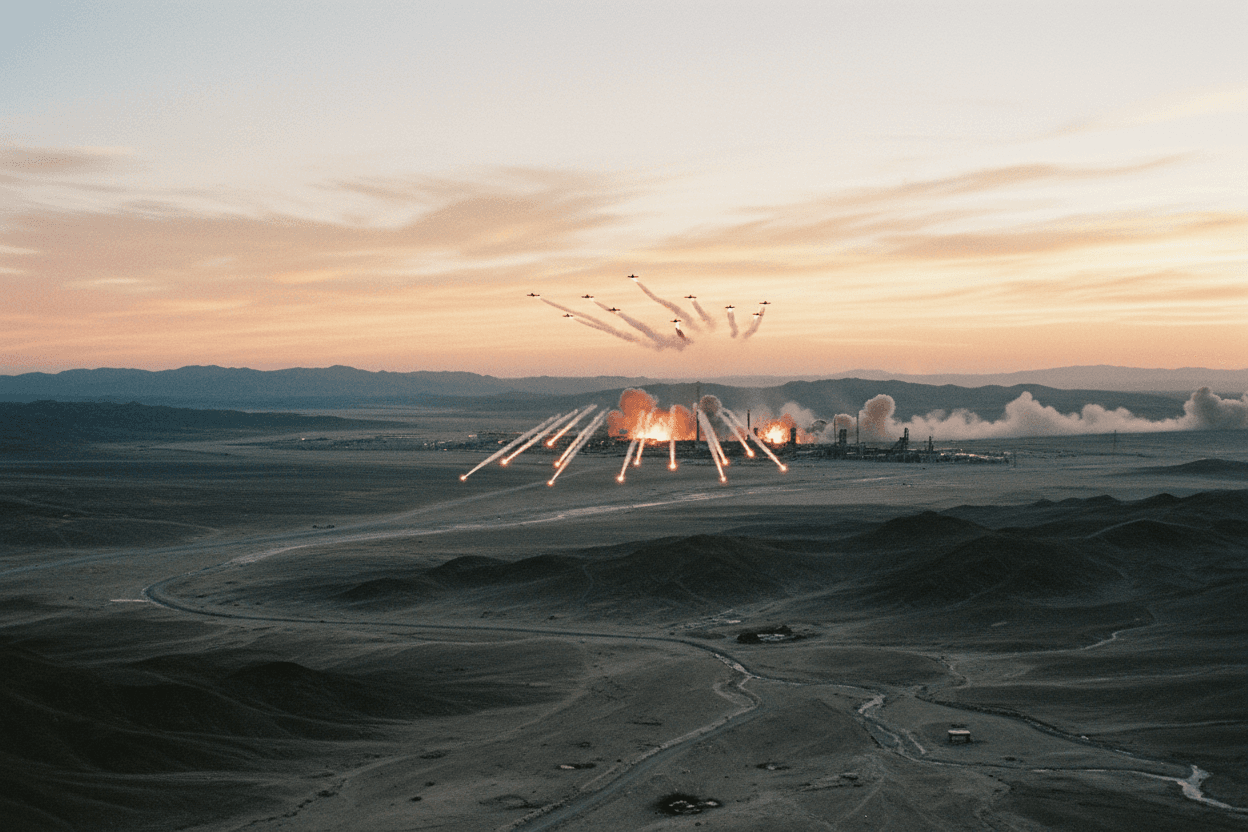
Israel launched a series of coordinated strikes against Iranian military targets early Saturday, with multiple explosions reported across Tehran and other strategic locations. The attacks, conducted in coordination with US forces, represent a dramatic escalation in Middle Eastern tensions and mark the most direct military confrontation between the longtime adversaries in recent years.
Residents in Tehran reported hearing loud explosions throughout the night as Israeli warplanes targeted what military sources described as "critical infrastructure and weapons facilities." The strikes focused on Iranian Revolutionary Guard Corps installations, missile production sites, and air defense systems across multiple provinces. Iranian state media confirmed the attacks but provided limited details about casualties or damage assessments.
The coordinated nature of the operation suggests months of joint planning between Washington and Jerusalem. US officials, speaking on condition of anonymity, confirmed American participation in intelligence gathering and logistical support for the strikes. The Biden administration justified the action as a response to what it called "escalating Iranian aggression" across the region, particularly Tehran's support for proxy groups targeting Israeli and American interests.
The attacks come amid heightened tensions following a series of escalatory moves by both sides over recent weeks. Iran had reportedly accelerated its uranium enrichment activities and increased arms shipments to allied militia groups in Syria, Lebanon, and Yemen. Israeli intelligence sources indicated that Tehran was preparing to transfer advanced weapons systems to Hezbollah, prompting urgent discussions between Israeli and American military leadership.
Regional allies expressed mixed reactions to the strikes, with Saudi Arabia and the United Arab Emirates calling for restraint while privately supporting efforts to curb Iranian influence. Egypt and Jordan, both key US partners, warned against further escalation that could destabilize the broader region. Turkey condemned the attacks as a violation of international law and called for an immediate ceasefire.
Oil markets reacted sharply to news of the strikes, with Brent crude futures surging more than eight percent in early Asian trading. Energy analysts warned that sustained conflict could disrupt shipping lanes through the Strait of Hormuz, through which approximately 20 percent of global oil supplies transit daily. Iran has previously threatened to close the strategic waterway in response to military action against its territory.
The Iranian response remained measured in the immediate aftermath, with government officials calling the strikes "an act of aggression" while stopping short of declaring immediate retaliation. Supreme Leader Ali Khamenei convened an emergency meeting of the National Security Council, but Tehran appeared to be calculating its options rather than launching immediate countermeasures. Military analysts suggested Iran might respond through proxy forces rather than direct confrontation.
International diplomatic efforts intensified as news of the strikes spread globally. The United Nations Security Council scheduled an emergency session for Sunday, with Russia and China expected to condemn the military action. European Union foreign ministers called for immediate de-escalation, while France and Germany offered to mediate between the parties. The International Atomic Energy Agency expressed concern about potential impacts on nuclear facilities.
The strikes targeted Iran's military capabilities across multiple domains, including air defense systems, missile production facilities, and naval installations along the Persian Gulf coast. Israeli military sources indicated the operation aimed to degrade Iran's ability to project power across the region while avoiding civilian casualties. Satellite imagery showed significant damage to several Revolutionary Guard facilities near Tehran and Isfahan.
Congressional leaders from both parties offered cautious support for the operation while demanding briefings on long-term strategy. House Speaker Mike Johnson called the strikes "necessary to protect American interests," while Senate Majority Leader Chuck Schumer urged the administration to prevent further escalation. Several lawmakers questioned whether the strikes received proper congressional authorization under the War Powers Resolution.
The economic implications extend beyond energy markets, with regional stock exchanges posting sharp declines and investors fleeing to safe-haven assets. The Tel Aviv Stock Exchange suspended trading after opening down more than five percent, while Iranian markets remained closed following the attacks. Defense contractors saw their shares surge amid expectations of increased military spending across the region.
Intelligence assessments suggest Iran possesses significant retaliatory capabilities despite the targeted strikes. Tehran maintains extensive proxy networks across Syria, Lebanon, Iraq, and Yemen, any of which could launch attacks against Israeli or American targets. The Revolutionary Guard's Quds Force, responsible for external operations, remained largely intact and capable of coordinating asymmetric responses.
The timing of the operation coincides with broader regional realignments, including ongoing efforts to normalize relations between Israel and Saudi Arabia. Some analysts suggested the strikes might actually accelerate Arab-Israeli cooperation against shared Iranian threats. However, others warned that military escalation could derail diplomatic progress and solidify regional divisions.
Looking ahead, both sides face difficult choices about escalation management and strategic objectives. Israel achieved tactical success in degrading Iranian military capabilities but now faces the challenge of preventing wider conflict. Iran must balance domestic pressure for retaliation against the risk of devastating military consequences. The coming days will likely determine whether this confrontation marks a turning point toward broader regional war or creates new opportunities for diplomatic resolution through demonstrated strength.